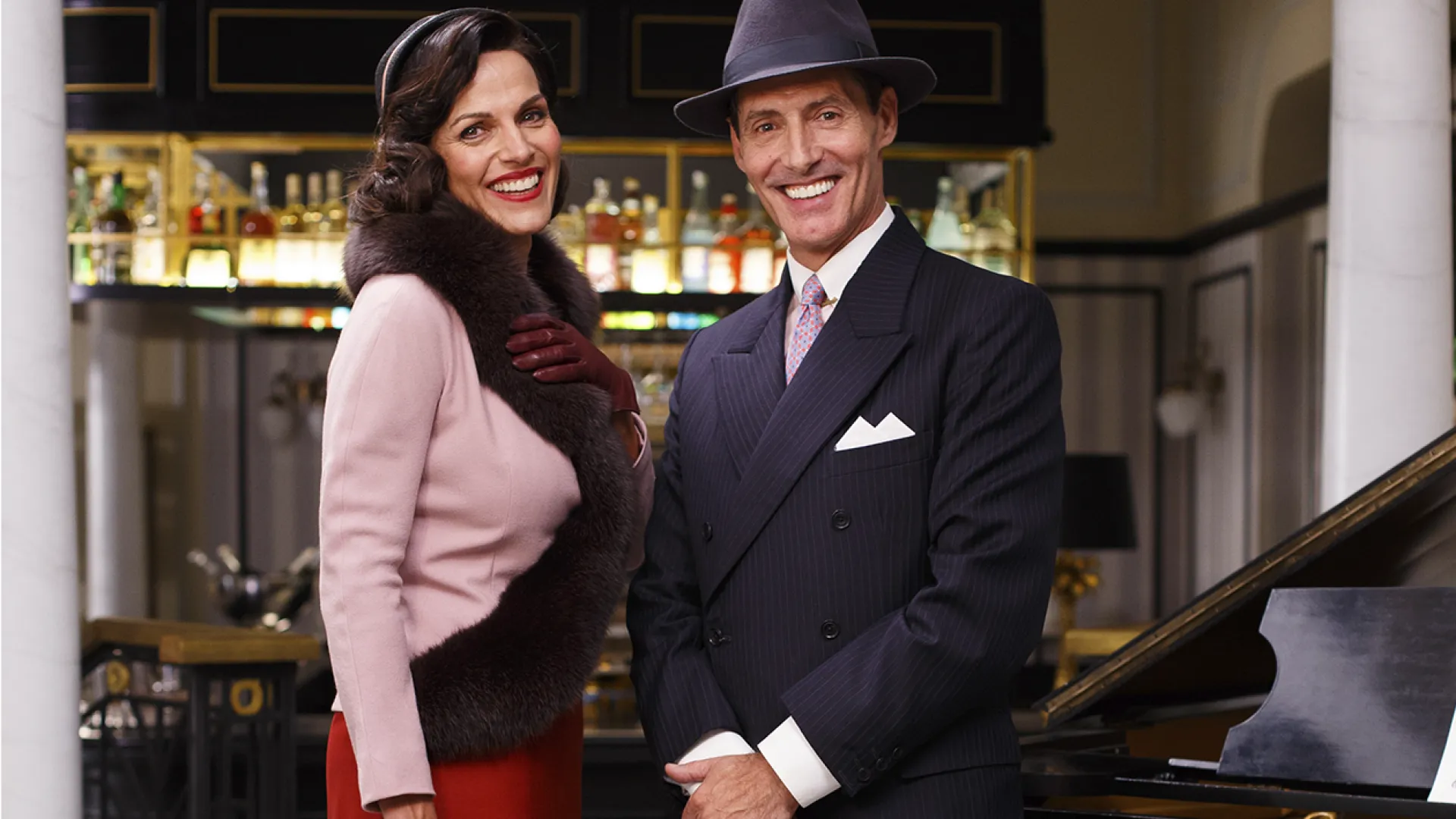
Eva Pedraza and Manuel Bandera star in new storylines in "La Moderna"
On Friday, November 24, two new characters will arrive: Doña Bárbara, Carla’s mother, and Fabio del Moral, a renowned diplomat.
Monday to Friday, at 4:30 p.m., on La 1 and RTVE Play.
Two new characters are joining the world of La Moderna, expanding its storylines starting Friday, November 24. This is when viewers will meet Doña Bárbara, the mother of the villainous Carla, played by Eva Pedraza; and Fabio del Moral, a prestigious diplomat from a well-known family of landowners from Málaga, played by Manuel Bandera.
Like her daughter, Doña Bárbara is an ambitious woman who embodies everything negative about Carla, multiplied by ten. With a tough personality, she hides her weaknesses behind irony and intelligence. She cares deeply for Carla, but their relationship is complicated, as she refused to help her when she left home. After her husband’s death, Doña Bárbara sought powerful men to maintain her social status. She arrives at La Moderna accompanied by an elegant diplomat to offer condolences to her daughter for the death of her husband, and she discovers that the young widow of Don Jaime Morcuende has inherited a large fortune.
Fabio del Moral is a renowned diplomat with political ambitions. He is determined, intelligent, and kind, and has also been successful in business. His family has been part of the country’s elite for generations. They are landowners from Málaga, with businesses focused on olives and olive oil; they also own shares in major banks, as well as a famous winery and a prestigious stud farm, where Fabio’s greatest passion—horses—is developed. Fabio was educated in elite boarding schools in England and Switzerland. After graduating in Law, he began his diplomatic career and, within a few years and without family influence, became an ambassador. In La Moderna, he reconnects with an old friendship with Íñigo Peñalver, who shares his passion for horses.
Episode 43 synopsis
The unexpected appearance of Doña Bárbara will unsettle her daughter. In addition to showing a certain interest in her—one Carla does not fully believe—her companion Fabio del Moral further confuses her. There is only one person who unsettles Doña Carla, and that is her mother. The extravagant and theatrical mother of Carla arrives at the gallery under the pretext of offering condolences for her son-in-law’s death, news she learned from the press while abroad. She is accompanied by Fabio del Moral, a career diplomat. It seems their stay will be brief, as they plan to continue their journey. However, Carla confesses the inheritance left by her husband, and Doña Bárbara now sees her daughter as a woman with power and money.
Meanwhile, Matilde will keep her job at La Moderna thanks in part to the strong support of her colleagues, and Marta will try to hide from them the fact that she has been begging.
La Moderna
La Moderna transports viewers to 1930s Madrid and the stories of employees and customers of an elegant, centrally located tea room. Based on the novel Tea Rooms by Luisa Carnés, it airs Monday to Friday on La 1, before La Promesa.
Co-produced by RTVE and Mediawan with the participation of Boomerang TV, it is filmed in real locations from early 20th-century Madrid and in over 2,500 m² of sets recreating the tea room, a grand shopping gallery, and the protagonists’ homes in a traditional courtyard building. Music plays an important role, with its main theme performed by Pastora Soler and composed by Tony Sánchez-Ohlsson.
Helena Ezquerro, Stéphanie Magnin, and Almagro San Miguel lead a large ensemble cast that also includes Miryam Gallego, Teresa Hurtado de Ory, and Sara Rivero, along with Llorenç González, Berta Castañé, and Bárbara Mestanza.
The production is led by Luis Santamaría and Humberto Miró, with direction by Liliana Bocanegra, Isaac Cantero, Pedro Martínez, and David Montoya. The writing team, coordinated by Carlos Martín Eguía and Joaquín Santamaría, includes Miquel Peidró, José Antonio López (Kata), Remedios Crespo, Ignasi Rubio, Juan Manuel Beiro, Ángela Armero, Neus Peidró, Sergio Barrejón, José Ángel Domínguez, and Laura Molpeceres.